
Learn how employee recognition programs boost retention, engagement, and productivity, and how to measure their ROI effectively - even globally.
Key Takeaways:
- Employee recognition programs deliver measurable business value by boosting engagement, productivity, and retention, and their impact can be quantified through ROI calculations.
- Regular and meaningful recognition is strongly correlated with lower turnover, higher retention rates, and improved employee motivation, with studies showing up to a 45% reduction in attrition.
- Tracking key metrics such as participation rates, satisfaction scores, redemption rates, and productivity improvements helps organizations refine gifting and recognition initiatives, ensuring global teams feel valued and the program drives real results.
When it comes to employee recognition programs, everyone loves a pat on the back - but does your business actually feel the payoff? Measuring the ROI of employee recognition shouldn’t solely be about numbers on a spreadsheet; but rather about understanding how appreciation drives engagement, retention, and productivity. In this blog, we break down the real value of saying “thank you” in ways that actually add up.
How to mathematically prove the value of recognition to a CFO?
We all know that recognition boosts morale, but when it comes to the CFO’s office, warm fuzzies won’t cut it. Finance leaders want numbers, formulas, and clear ROI. Luckily, employee recognition programs can be measured and quantified, and showing the math can turn your a feel-good initiative into a strategic business case.
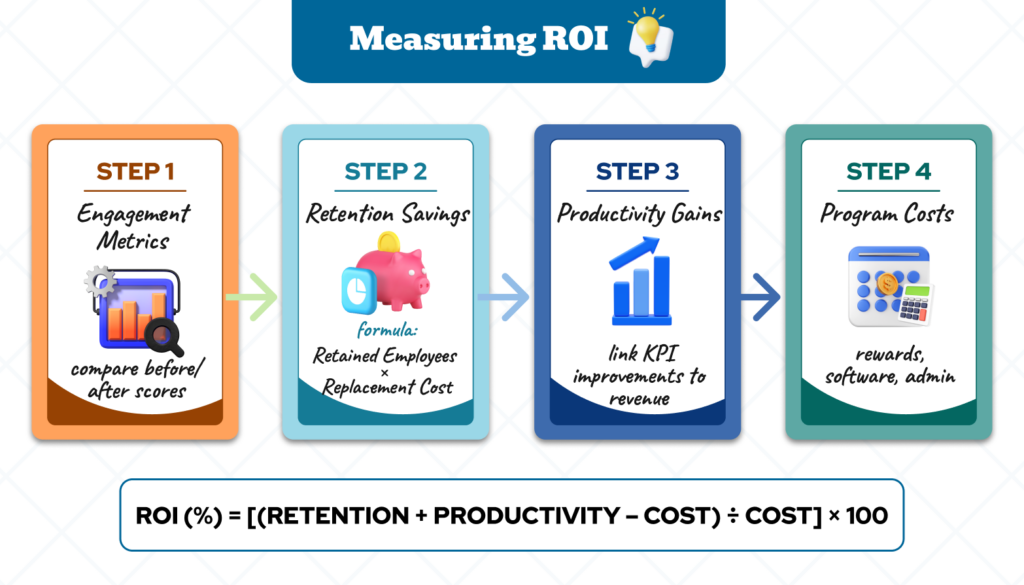
Start with Engagement Metrics
Recognition directly impacts employee engagement, which in turn influences productivity and retention. Track baseline engagement scores before implementing a program and compare them after a set period. Higher engagement often translates to measurable gains: reduced absenteeism, faster project completion, and increased output.
Tie Recognition to Retention and Turnover Costs
Turnover is expensive. Estimate the cost of replacing an employee; including recruiting, onboarding, and lost productivity. Then calculate how recognition improves the employee retention rate. Even a small turnover reduction percentage can potentially save the company thousands of dollars each year.
Formula example:
Retention Savings = (Employees retained due to recognition) × (Average turnover cost per employee)
Link Recognition to Productivity Gains
We all know that when employees feel appreciated, they are more likely motivated. To successfully demonstrate the effect of employee recognition programs, measure improvements in KPIs, such as sales per employee, project completion rates, or customer satisfaction scores. Multiply the productivity gain by revenue per employee to quantify a financial impact.
Factor in Cost of Recognition Program
List the total costs: rewards, software, administrative time, and training. Comparing this against the savings from retention and productivity provides a clear ROI percentage.
Formula example:
ROI (%) = [(Total savings from retention + productivity gains – Program cost) ÷ Program cost] × 100
Present the Story with Numbers and Context
CFOs respond best to concise, evidence-backed presentations. Use charts showing cost savings, productivity increases, and retention improvements. Highlight that recognition is an investment that pays dividends in both dollars and culture.
What is the statistical correlation between recognition frequency and retention rates?
Multiple studies have shown a clear statistical relationship between how frequently employees receive recognition and how likely they are to stay with an organization. For example, longitudinal research from Gallup and Workhuman tracking nearly 3,500 employees over two years found that those who received high‑quality recognition were about 45% less likely to leave their jobs compared with peers who did not feel equally recognized, indicating a strong inverse correlation between recognition frequency and turnover.

Additionally, organisations with robust recognition practices consistently report up to 31% lower voluntary turnover rates, further reinforcing that regular, meaningful appreciation contributes to greater retention. These figures demonstrate that increasing the frequency and quality of recognition isn’t just good for morale, it’s statistically associated with keeping more employees on board over the long term.
How much does productivity increase when employees feel appreciated?
When employees genuinely feel appreciated, it can tangibly boost performance. Research shows that organizations with strong recognition cultures report about a 14% increase in productivity and engagement compared with those that don’t prioritize appreciation, underscoring that valued employees deliver more and perform better at work.
Recognition and employee appreciation foster a sense of purpose and belonging, encouraging employees to go above and beyond in their roles. This heightened motivation often translates into faster project completion, improved collaboration, and higher-quality outputs. Over time, consistent appreciation also reduces burnout and absenteeism, creating a sustainable cycle of performance where employees feel invested in the company’s success.
What metrics should be tracked to measure the success of a gifting program?
To measure the success of a gifting program, it’s essential to track a combination of quantitative and qualitative employee recognition metrics. Key indicators include participation rates, which reveal how many employees or clients are engaging with the program, and redemption or fulfillment rates, showing whether gifts are being received and used as intended. Monitoring employee or recipient satisfaction scores, along with feedback and sentiment, provides insight into the program’s perceived value and impact on morale. Additionally, linking gifting initiatives to retention, engagement, and productivity metrics can help quantify their broader business impact. By regularly analyzing these metrics, organizations can refine their gifting strategies, ensuring each initiative delivers measurable ROI and strengthens relationships.

How long does it take to see a return on investment from culture initiatives?
Understanding the timeline for seeing a return on investment from culture initiatives is critical for setting realistic expectations with leadership. While some early indicators, such as increased participation in engagement activities or improvements in morale, can emerge within the first few months, most organizations begin to observe measurable business outcomes like enhanced retention, productivity, and reduced turnover within about 6–12 months of consistent implementation.

For example, research from HR solutions firms suggests that recognition programs typically show initial engagement improvements in the first 90 days, with more substantive impacts on retention and performance becoming apparent over the longer 6‑ to 12‑month period of sustained effort.
Recognition without borders: How Giftsenda can help
Employee recognition programs are most effective when they are consistent, meaningful, and easy to manage - even across borders. A global gifting platform, like Giftsenda, can make it simple to select, deliver, and track gifts for employees worldwide, ensuring remote and global teams feel truly valued. By handling the logistics, Giftsenda allows organizations to focus on meaningful recognition while still measuring its impact on engagement, retention, and overall culture.
