
 Download Bulk Order Form
Discover how to build a strong CFO-approved case for direct mail with ROI insights, attribution tips, and proven revenue impact strategies.
Key Takeaways:
- Direct mail is most effective when it is framed in commercial terms, linking spend directly to measurable outcomes like pipeline growth, conversion rates, and revenue impact rather than traditional marketing metrics.
- Clear attribution methods, such as QR codes, unique URLs, and CRM tracking, are essential for demonstrating performance and closing the visibility gap that often concerns finance teams.
- When properly targeted and measured, direct mail can act as a high-impact complement to digital channels, improving engagement and standing out in increasingly saturated marketing environments.
For many finance leaders, direct mail sits in the “nice idea, hard to measure” category, often overshadowed by digital channels that promise instant metrics and lower upfront costs. Yet, when executed strategically, direct mail consistently delivers higher engagement rates, stronger brand recall, and a tangible return that digital overwhelm simply can’t match - making it far less of a gamble and far more of a smart, if slightly underappreciated, investment. In this blog, we’ll break down how to make a compelling, numbers-driven case that turns skepticism into buy-in (and maybe even earns you a rare approving nod from finance).
How to build a business case for direct mail investment?
Building a business case for direct mail investment starts with reframing it from a “marketing expense” to a revenue-driving channel.
Typically, CFOs are looking for clarity, predictability, and return. That means your case needs to anchor every argument in measurable impact, not just good intentions. When framed around clear commercial outcomes, such as pipeline acceleration, higher conversion rates, or increased customer lifetime value, it becomes easier to evaluate alongside other revenue-driving activities.
Direct mail’s value lies in its ability to cut through digital saturation and drive meaningful engagement, particularly when targeted at high-value accounts. When supported by realistic performance benchmarks and clear attribution methods, it demonstrates that it can deliver both impact and accountability.
What pilot data do you need to show the CFO?
To secure CFO buy-in, pilot data needs to demonstrate both effectiveness and efficiency in clear financial terms. This includes response rates, conversion rates, and pipeline or revenue generated from the campaign; showing a direct link between spend and business outcomes.
Equally important is cost visibility. Data should reflect cost per send, cost per response, and ultimately cost per acquisition, allowing for easy comparison with other marketing channels. When paired with engagement insights, such as meeting bookings or customer interactions, it helps illustrate not just reach, but real impact.

Strong pilot data reduces uncertainty. It provides tangible evidence that direct mail can deliver measurable returns, making future investment decisions less about assumption and more about proven performance.
How to explain the "attribution gap" to finance teams?
The attribution gap refers to the challenge of fully capturing how and where marketing influence turns into revenue; especially when customer journeys span multiple touchpoints and channels. In many cases, finance teams expect a clear, linear path from spend to conversion, but real-world buying behaviour is rarely that straightforward.
In direct mail, this gap often appears when recipients engage offline or through delayed digital actions that aren’t immediately traceable to the original touchpoint. A prospect might receive a piece of mail, visit the website days later, or convert through a different channel entirely; making the true impact harder to attribute using standard reporting models.
Explaining this to finance teams is about reframing attribution not as a lack of performance, but as a limitation of visibility. The goal is to show that while the full influence may not always be perfectly tracked, consistent patterns in lift, engagement, and pipeline contribution still demonstrate meaningful commercial impact.
What are the tax benefits of marketing expenses vs. gifts?
In most tax systems, including the U.S., marketing expenses and business gifts are treated quite differently, and that difference can meaningfully affect how much of the spend is ultimately deductible.
Marketing expenses, such as advertising, direct mail campaigns, promotional materials, or digital ads, are generally considered ordinary and necessary business expenses. This means they are typically fully tax-deductible, provided they are directly tied to promoting the business and generating revenue. There’s usually no strict per-recipient cap, as long as the spend is clearly commercial in nature.
Business gifts, however, are more restricted. In the U.S., for example, the IRS generally limits deductions for business gifts to $25 per recipient per year, with only limited exceptions. Anything above that threshold is typically not deductible as a business expense. There are also additional rules around what qualifies as a “gift” versus promotional or marketing material, which can further affect deductibility.
This distinction is why how an item is classified matters. A branded item sent as part of a broader campaign may be treated as marketing, while a standalone gift with no promotional context is more likely to fall under the stricter gift rules.
It’s worth noting that tax treatment can vary by jurisdiction and specific circumstances, so companies often structure programs carefully to ensure spending is categorized in the most favorable and compliant way.
How to align direct mail goals with company revenue targets?
Aligning direct mail goals with company revenue targets starts with connecting each campaign to a clear commercial outcome rather than a standalone marketing metric. Instead of focusing on outputs like send volume or impressions, the emphasis shifts to revenue-linked indicators such as pipeline contribution, deal velocity, or customer acquisition within a defined segment.
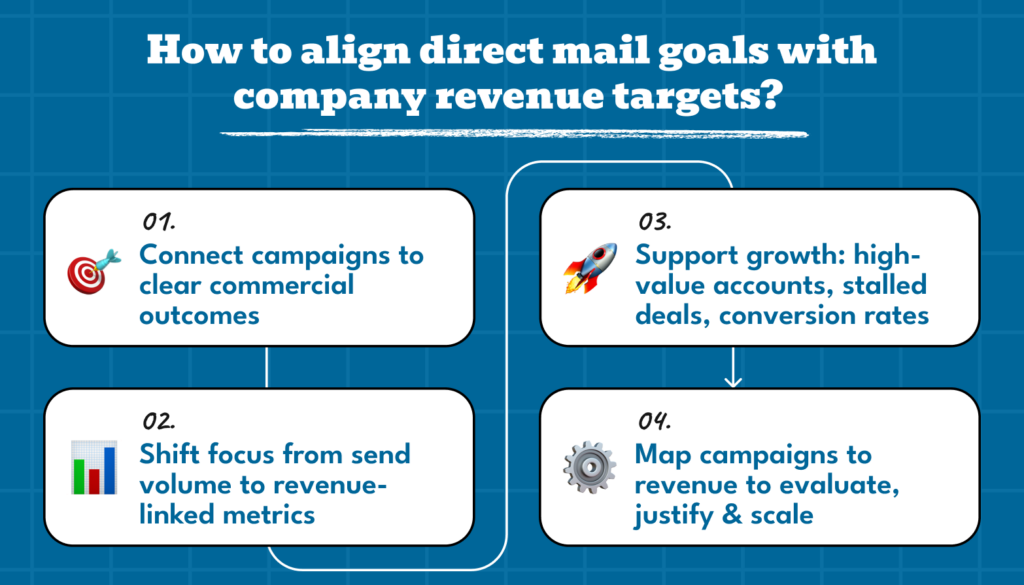
Direct mail is most effective when it supports specific growth priorities, whether that’s opening high-value accounts, accelerating stalled deals, or increasing conversion rates, so its success can be measured in terms that matter to the business. By mapping campaigns directly to revenue goals, direct mail becomes easier to evaluate, justify, and scale as a performance-driven channel.
Turning Direct Mail into a Measurable Growth Engine with Giftsenda
Giftsenda can help bridge the gap between direct mail activity and measurable business outcomes by making it easier to plan, execute, and track global gifting and direct mail campaigns in a structured, data-driven way. Instead of managing multiple vendors and fragmented logistics, teams can centralize campaigns in one platform, ensuring consistency, control, and visibility across regions.
By enabling targeted delivery at scale, Giftsenda supports more precise audience segmentation; helping ensure that direct mail efforts reach the right accounts at the right stage of the customer journey. Built-in tracking and reporting also help connect gifting and mail activity to downstream engagement, making it easier to demonstrate impact in terms that resonate with finance teams, such as pipeline influence and conversion uplift.
In practice, this means direct mail shifts from being a hard-to-measure tactic to a coordinated, performance-aligned channel that supports broader revenue goals.
FAQs
Why do CFOs hesitate to approve direct mail budgets?
CFOs often hesitate due to perceived high costs and limited visibility on ROI. Without clear attribution and performance data, direct mail can appear harder to justify compared to digital channels with instant, granular reporting.
How can direct mail ROI be proven?
ROI can be demonstrated through tracked responses, conversion rates, and pipeline impact. Using unique URLs, QR codes, and CRM tracking helps link direct mail engagement directly to revenue outcomes and business performance.
Is direct mail still relevant in a digital-first world?
Yes. Direct mail stands out in saturated digital environments, driving higher engagement and recall. When targeted and measured effectively, it complements digital channels and strengthens overall campaign performance.
